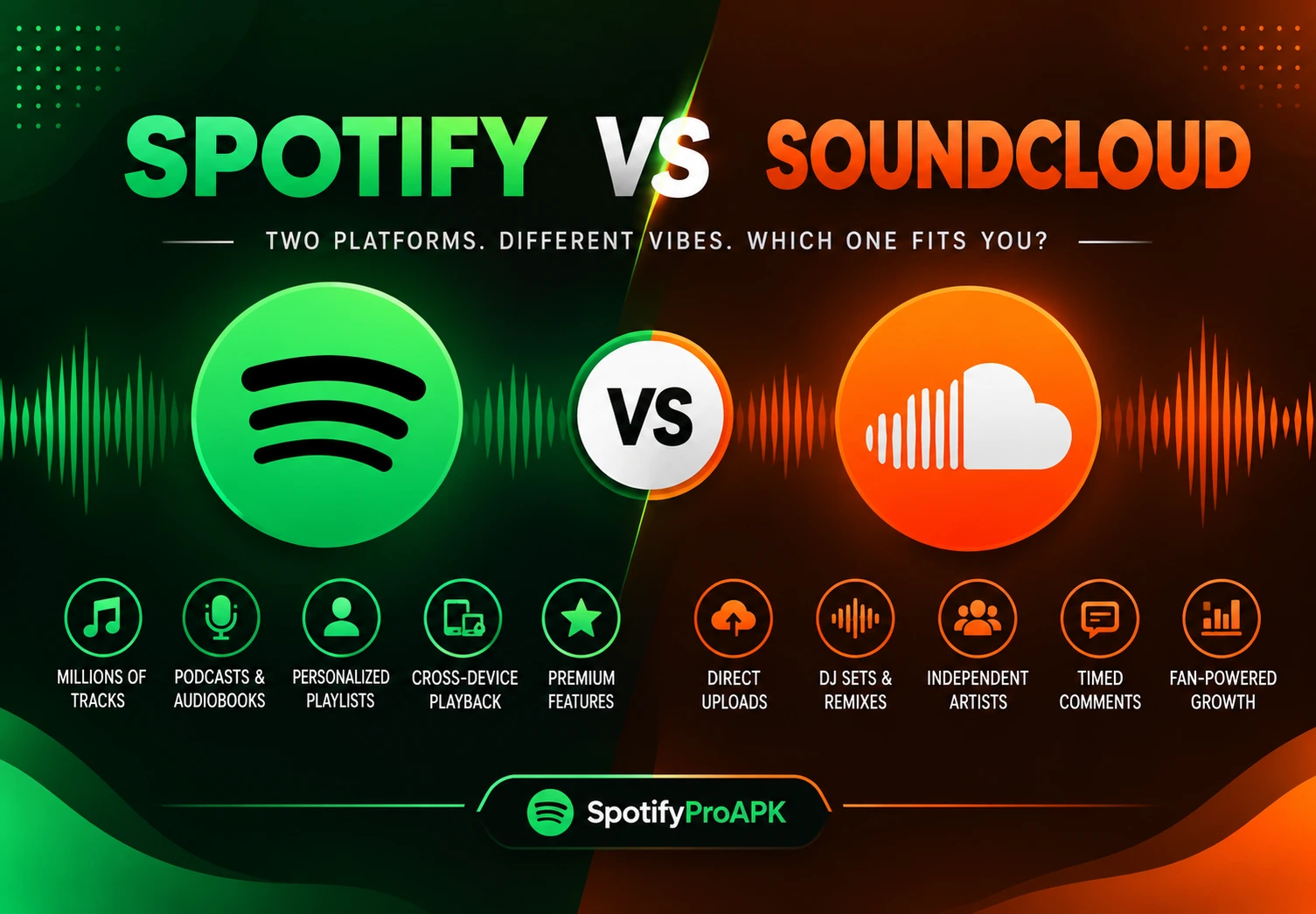
Spotify vs SoundCloud: Complete Comparison of Features, Price & Music Quality 2026
Spotify vs SoundCloud at a Glance
What Is Spotify?
Spotify is a leading audio platform with millions of music tracks, podcasts, and audiobooks. Spotify provides high-quality audio, personalized recommendations, and allows you to create playlists, with tons of modern features like an AI-powered personalized DJ. Here is the complete Spotify breakdown in terms of features, issues, best practices, along with version history.
Key Features of Spotify
- Personalized mixes (Discover Weekly, Release Radar)
- Licensed music, podcasts, & audiobooks
- Social features (Collaborative Playlists, Jam, Wrapped)
- Seamless cross-device playback (Spotify Connect)
- High-quality audio, lyrics, & music videos
What Is SoundCloud?
SoundCloud was developed by the Swedish sound designer Alexander Ljung and Swedish musician and computer scientist Eric Wahlforss in 2007 which publicly lived in 2008.
SoundCloud focuses on artist discovery; it lets artists share and find music,c especially new talent. SoundCloud has an extensive digital stage, particularly for those who are rising talent. They can easily get an audience and praise. The main objective of SoundCloud is fostering a community where new talent is encouraged and nourished
Key Features of SoundCloud
- Direct open audio uploads
- Timed waveform comments
- Independent tracks, DJ sets, demos, & bootlegs
- Social reposts & direct messaging
- Fan-powered artist monetization & analytics
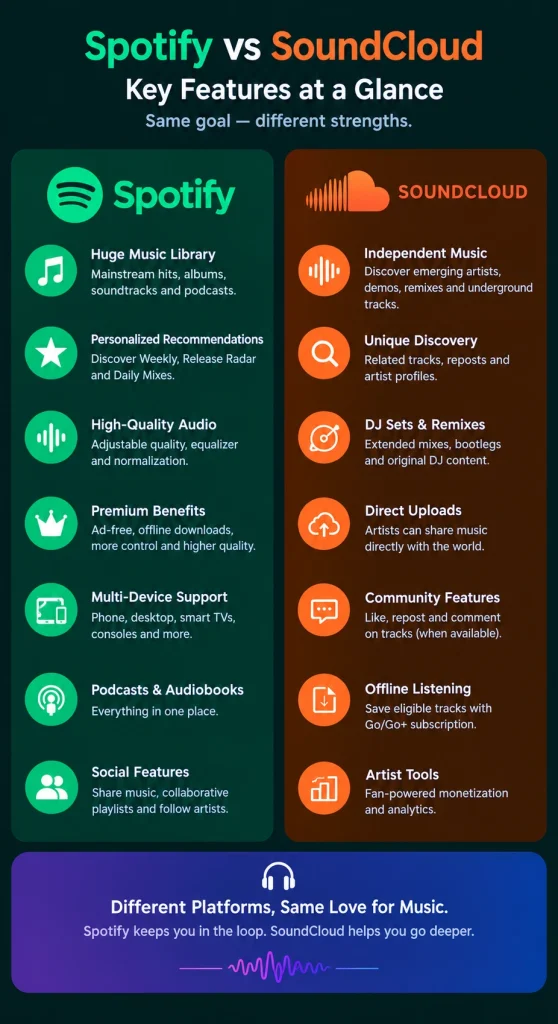
Spotify vs SoundCloud: Feature Comparison
Music library and catalog
Spotify has a broad range of mainstream songs, albums, and soundtracks. It also has independent releases, meaning Spotify produces them; users can follow artists and browse official discographies. Despite its extensive library, few unofficial remixes, bootlegs, and DJ edits are available because of licensing restrictions.
SoundCloud is known for music streaming with creator uploads. As a result, users can find independent artists, demos, underground tracks, and experimental music. SoundCloud is a good place to find emerging talent, with its vast library consisting of ver 100 million to 125 million sound tracks.
Music discovery and recommendations
Spotify recommends songs, artists, and playlists based on your listening history. It uses features such as Discover Weekly, Release Radar, and Daily Mixes to analyze users” mood anpreferenceses. It gives high accuracy for finding artists similar to ones you know, along with exploring familiar genres and keeping up with new releases.
SoundCloud solely relies on recommendations for music through related tracks, reposts, artist profiles, and genre-based recommendations. It helps find underground musicians and rising talent, but sometimes it fluctuates in mood and always repeats the same genre, while Spotify adds new tracks on its own. This platform is great for underground musicians, emerging producers, and niche music that may not appear on mainstream streaming platforms.
Audio quality
Spotify offers adjustable streaming quality in terms of audio quality, along with audio normalization and equalizer controls on supported devices. This feature helps users get a better experience because the audio is auto-adjustable on devices like headphones, Bluetooth speakers, and car audio.
While SoundCloud lacks adjustable audio, its audio quality depends on the uploaded recording and the available streaming format. By buffering, SoundCloud Go+ provides higher-quality streaming for eligible tracks. But individual uploads of audio can differ a lot depending on their source.
Free listening experience
Spotify offers many plans; the Free plan is one of those that gives you a large music catalog, personalized recommendations, and playlists without a paid subscription. But on the Free plan, users have to see Advertisements, can have mobile playback restrictions, and limits on song selection can affect the experience. You can overcome this issue by downloading our APK spotify premium APK.
SoundCloud allows you to stream many tracks on SoundCloud for free, including independent releases, DJ mixes, and music from emerging artists. However, the independent releases depend on the content and your region, along with advertisements and subscription requirements for certain tracks. It can also have playback restrictions.
Premium features
Spotify Premium offers many features like ad-free music, offline downloads, more playback control, and higher audio quality depending on the plan and market any many more. This is designed for those who want uninterrupted music and more control over how they listen.
SoundCloud’s ad-free listening depends on the Go and Go+ offer. Go+ also gives access to the full eligible catalog and higher-quality streaming. SoundCloud DJ is available for compatible DJ software, which makes it useful for DJs and music enthusiasts.
Offline listening and downloads
Spotify Premium lets you download songs, albums, and playlists for offline listening in supported apps. Free users can also download podcasts. Downloaded music stays available in the app, subject to subscription requirements and periodic internet verification.
SoundCloud Go and Go+ let you save eligible tracks for offline listening within the app. Offline availability depends on your subscription and the track’s rights, and downloaded content is not a permanent audio file you can freely transfer to other players.
Playlists and music library
Spotify lets you create playlists, save albums, like songs, follow artists, and organize your collection by mood or activity. Collaborative playlists let friends add songs to a shared collection. Learn more about playlists in this guide.
SoundCloud also supports playlists. It creates a collection of liked tracks, reposts, and artist follows. This suits collecting music from independent producers and niche genres. The Saved tracks can become unavailable if creators remove them or distribution rights change.
Podcasts and other content
Spotify doesnot limits it self to songs; it has hundreds of thousands of thousaof nds podcasts, spoken-word shows, and audiobooks as well. It allows you to follow shows, save episodes, and download eligible content; it aims to provide a full experience of audio, not just music.
Similarly, SoundCloud hosts music alongside interviews. It also offers creator-uploaded podcasts, radio-style shows, which are similar to SpotifyDJ, and independent audio productions. If you want mainstream podcasts and audiobooks, Spotify’s dedicated content experience is more convenient.
Remixes, DJ sets, and independent music
Spotify has official releases with electronic music alongside licensed remixes and curated DJ-inspired playlists. It comes with the downside that unofficial extended edits and some independent mixes may be unavailable because of licensing restrictions.
SoundCloud is popular for unofficial remixes, DJ sets, underground hip-hop, electronic music, and independent productions. Its creator focus gives you more chances to find experimental music, though copyright restrictions can affect which tracks are available.
Social and community features
With Spotify, you can share songs, albums, and playlists, create collaborative playlists, and use supported social listening features. These features help you swap recommendations and listen to music with friends. You can make your playlists, remotely share your taste,e and create a collaborative community.
SoundCloud has a more creator-focused community. You can follow artists, like tracks, repost music, and comment on specific moments in a track when commenting is available. That lets listeners connect with creators and give them direct feedback.
User interface and ease of use
Spotify has a cleaner, more polished interface, including search, personalized recommendations, playlists, and an organized library. Spotify’s Navigation is straightforward, so songs are much easier to find, and playback is easy to manage.
SoundCloud’s interface has more focus on track discovery, creator profiles, uploads, and community activity. It encourages exploring emerging music, but finding a specific version of a song can be hard because multiple uploads and unofficial edits may exist.
Device compatibility
| Requirement | Spotify | SoundCloud |
| Android | Compatible Android OS | Compatible Android OS |
| iOS | Compatible iOS | Compatible iOS |
| Desktop | Windows and macOS | Supported web browsers |
| Browsers | Chrome, Firefox, Edge, Safari | Chrome, Firefox, Edge, Safari |
| Internet | Required for streaming | Required for streaming |
| Offline Listening | Available with Premium | Available for selected tracks with eligible plans |
Data usage
Spotify allows you to adjust streaming quality and use Data Saver on supported devices to reduce mobile data usage. Data usage depends on the quality you are using. Premium subscribers can also download playlists over Wi-Fi for offline listening, which cuts repeated streaming while travelling.
SoundCloud’s data use depends on streaming quality, track format, and how long you listen. Eligible offline downloads reduce repeated streaming, and Go+ subscribers should keep in mind that higher-quality playback may use more data than standard streaming.
Spotify vs SoundCloud for Artists & Creators
| Feature | Spotify | SoundCloud |
| Music Uploading | Through distributors or record labels | Direct uploads to artist profiles |
| Artist Profiles & Audience | Artist profiles, playlists, and recommendations | Profiles, comments, reposts, and followers |
| Analytics & Creator Tools | Spotify for Artists provides streaming and audience insights | SoundCloud for Artists offers listening statistics and promotional tools |
| Monetization | Royalties through rights holders and distributors | Monetization for eligible creators, including fan-powered royalties |
| Music Distribution | Requires a digital distributor or label | Direct uploads and distribution services for eligible creators |
Spotify vs SoundCloud Pricing & Plans
| Plan | Price | Ads | Offline Listening | Full Catalog | Audio Quality | Best For |
| Spotify Free | Free | Yes | Yes | Limited features | Standard | Casual listeners |
| Spotify Premium | From $11.99/month | No | yes | yes | High quality | Everyday music streaming |
| SoundCloud Free | Free | Yes | No | No | Standard | Discovering independent music |
| SoundCloud Go | $4.99/month | No | Yes | No | Standard | Ad-free & offline listening |
| SoundCloud Go+ | $10.99/month | No | Yes | No | High quality | Full SoundCloud catalog |
| SoundCloud DJ | $19.99/month | No | Yes | No | High quality | DJs and offline mixing |
Spotify vs SoundCloud: Pros & Cons
Spotify Pros and Cons
Spotify Pros
Spotify Cons
Pros and Cons of SoundCloud
SoundCloud Pros
SoundCloud Cons
Frequently Asked Questions
Final Verdict
Spotify and SoundCloud serve different music listening needs. Spotify is a better choice for mainstream songs, personalized playlists, podcasts, and a smooth listening experience. SoundCloud stands out for discovering emerging artists, underground tracks, remixes, and DJ sets. Both platforms offer free and paid plans, with offline listening available through eligible subscriptions. Ultimately, choose Spotify for an organized music experience and SoundCloud if you want to explore new sounds and support independent creators.